★★★
Budget
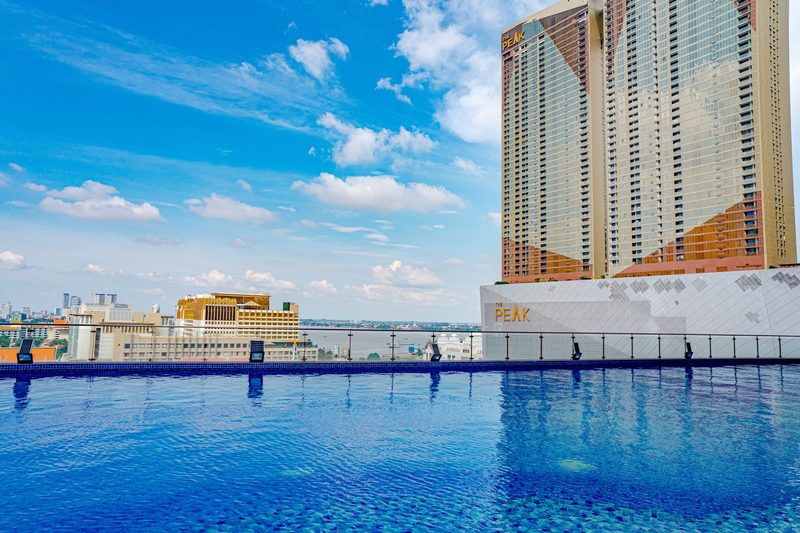
Phnom Penh Infinity Pool Down to $25/N - M Residence
From $43 / night
Check Prices on Trip.com →

June weather, activities, events & insider tips
Long-run averages for June
Weigh the advantages and considerations before booking
Top things to do during your visit
June mornings are your window for the Royal Palace and Silver Pagoda. The Throne Hall's spired roof catches early light. Inside the Silver Pagoda, over five thousand silver tiles pave the floor, reflecting dim doorway glow that afternoon glare washes out. June's thin crowds let you stand before the Emerald Buddha without being herded. Gardens smell of jasmine and damp stone. The Ream Ker murals wrapping the inner gallery wall tell the Cambodian Ramayana in panels worth an hour of reading. Arrive at 8 AM opening. By 10:30 AM, stone pathways radiate heat. Contemplation becomes endurance.
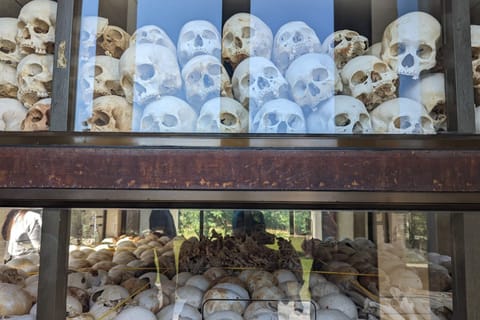
Understanding Phnom Penh demands confronting 1975 to 1979. The former S-21 detention centre at Tuol Sleng and the Choeung Ek killing fields, 15 km (9.3 miles) south, rank among Southeast Asia's most important memorial sites. June's low numbers make the experience more private. More fitting. At Tuol Sleng, iron bedframes and shackle bolts sit in empty rooms where your footsteps on tile and rain on the roof are the only sounds. Choeung Ek's memorial stupa holds skulls arranged by age and method of death, standing in a field where wet-season grass grows thick and green, where cloth fragments still surface after heavy rains. These visits hurt. They are necessary. Start early. Allow three to four hours. Plan something quiet after.
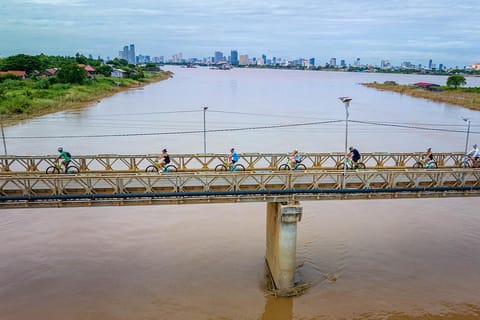
Three rivers meet at Chaktomuk. The Tonle Sap, the Mekong, and the Bassac converge right in front of Phnom Penh's riverfront. This geographical accident turns an ordinary city view into something worth a slow boat ride. In June the rivers rise and run brown with silt. The water climbs noticeably higher against the stilted fishing houses along the banks. The sky breaks open in streaks of copper and violet after afternoon rain clears. Boats depart from piers along Sisowath Quay around 5 PM. They cruise past the Royal Palace floodlit on the western bank. They reach the Chaktomuk junction and loop back as the light fades. You can smell charcoal smoke drifting from riverbank cooking fires. You hear long-tail boat engines puttering upstream. The breeze off the water is the closest thing to relief from the humidity you will find all day. Even on overcast evenings the light show is worth it. A post-rain clear sky is the jackpot.
The wet season does not slow down Phnom Penh's market life. If anything, the canopied stalls of Psar Thmei feel more alive when rain drives foot traffic under cover. The 1937 Art Deco central market has a yellow dome rising over the intersection of Streets 63 and 136. The food stalls lining the back corridors serve kuy teav from pre-dawn onward. This rice noodle soup comes with pork broth and a fistful of bean sprouts. Steam rising from the bowls mixes with the wet-pavement smell of the market floor. A morning food walk threads from Psar Thmei south to Psar Tuol Tom Poung, the Russian Market. The route covers about 3 km (1.9 miles). It hits the full range. Nom krok are crispy coconut rice cakes cooked in a cast-iron hemisphere mold. Their edges turn brown and centers stay custardy. Bai sach chrouk is the national breakfast: thinly sliced pork grilled over charcoal and laid on broken rice with a bowl of clear broth on the side. For the willing, fried tarantulas and crickets come from vendors near Psar Chas. Their oil pops and crackles as the legs curl. The sensory load is total: fish sauce, lemongrass, wet cardboard boxes, and the sweet rot of overripe jackfruit.
Koh Dach, known as Silk Island, sits in the Mekong about 10 km (6.2 miles) north of central Phnom Penh. In June the short ferry crossing gives you a front-row view of the river running high and fast. Muddy water carries branches and the occasional fishing net downstream. The island itself is flat, green, and quiet. A network of dirt paths connects family-run silk workshops. Women work wooden looms under stilted houses. The rhythmic clack of the shuttle is audible before you see them. Raw silk thread is dyed in vats of natural color drawn from lac insects and bark. It hangs in skeins from the rafters to dry. The whole space smells of wet wood and the faintly metallic scent of the dye. In June the paths between villages are muddy but walkable. The mango trees drip. The lack of tourists means the weavers have time to walk you through the entire process from cocoon to finished ikat pattern. Cycling is the best way to cover the island. It stretches roughly 5 km (3.1 miles) end to end. Rentals are available at the ferry landing. The afternoon rain usually chases you back to the covered weaving areas. This is a feature, not a problem.
Wat Phnom, the hilltop temple that gave the city its name, sits on a 27 m (89 ft) artificial mound at the northern end of the old quarter. In June the surrounding park is dense with rain-fed foliage. The staircase is flanked by naga balustrades slick underfoot. The air is thick with incense smoke and the sound of resident macaques crashing through the canopy above. The temple itself is small enough to see in twenty minutes. The point is less the building than the view from the top. You see the Tonle Sap running wide and brown to the east. You see the rooftops of the colonial-era buildings along Street 94 below. You see the Independence Monument's lotus-petal silhouette to the south. From Wat Phnom you can walk south through the old French Quarter. Streets are still lined with shuttered colonial facades. You pass Wat Ounalom, the seat of Cambodian Buddhism since the fifteenth century. You continue down to the riverfront. The walk is roughly 2 km (1.2 miles). It takes forty-five minutes at a sightseeing pace if you start early, before 8 AM. The heat is still bearable then. The monks at Wat Ounalom are finishing their morning chants. The low murmur is audible from the courtyard gate.
Hand-picked hotels across price tiers for June travellers.
Dates that affect opening hours, transport and crowds
Known in English as Queen Mother's Birthday. Observed nationwide as a public holiday.
Known in English as Queen Mother's Birthday. Observed nationwide as a public holiday.
Bookmark this page — your progress is saved between visits
Climate-specific gear, brand recommendations, and what to leave at home.
View Phnompenh Packing List →Insider knowledge and common pitfalls to avoid
Now that you've got the research covered, here's where to go next.
Top-rated things to do in Phnompenh this June
Didn't see anything interesting yet?
Browse Viator's full catalog of tours, day trips, food experiences, and private guides in Phnompenh.
See All Phnompenh Tours on Viator