
★★★
Budget
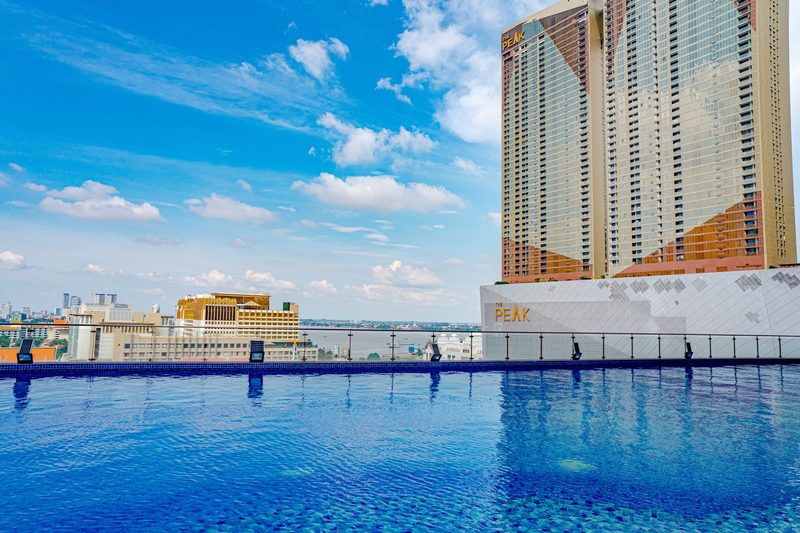
Phnom Penh Infinity Pool Down to $25/N - M Residence
From $43 / night
Check Prices on Trip.com →

May weather, activities, events & insider tips
Long-run averages for May
Weigh the advantages and considerations before booking
Top things to do during your visit
May marks the hinge between dry heat and the monsoon's first serious push across Phnom Penh. The thermometer still touches 34°C most afternoons. The air carries a thickness that earlier months only hinted at, a warm, close weight settling over the Tonle Sap riverfront by midmorning. It doesn't lift until after dark. But May also brings the first dependable rains, roughly 119 millimetres through the month. They arrive as sharp, theatrical downpours that crack open around mid-afternoon, hammer the tin roofs of Psar Thmei for twenty or thirty minutes, then pull back to leave streets smelling of wet laterite and softened dust. Between those bursts, the sky clears to pale, washed-out blue. This feels distinctly different from the hard glare of February or March. The Mekong begins to swell. Along Sisowath Quay, water creeps a few centimetres higher each week, a slow visual calendar for a season that will peak months later. For visitors, the shift is practical. Phnom Penh's major landmarks, the Royal Palace, Tuol Sleng, the Killing Fields at Choeung Ek, remain open year-round. The early wet season thins crowds noticeably compared to the December-through-March peak. Hotels across the city drop into shoulder-season pricing. This means better rooms for less outlay at properties along the riverfront and in the BKK1 quarter. Mornings are the golden window. The light is softer than in dry months. Temperature still hovers in the high twenties before ten o'clock. Tuk-tuk drivers are less harried. By early afternoon, heat builds toward its daily peak. Locals retreat indoors. This is the hour to find an air-conditioned café on Street 240, or sit under ceiling fans at a Riverside beer garden, listening to distant thunder building over the Bassac River. Evenings in Phnom Penh cool only slightly. Post-rain dusk carries the scent of frangipani and charcoal smoke from street-food carts lining Preah Norodom Boulevard. The city's night markets come alive with lok lak sizzling on flat-top grills and green mango salad dressed with fish sauce and palm sugar.
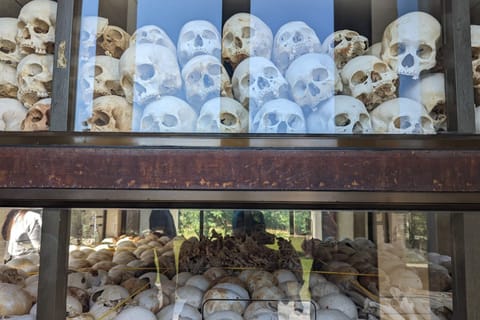
The drive from central Phnom Penh to Choeung Ek takes about forty minutes by tuk-tuk. You pass through the city's southern sprawl until the road narrows and noise drops away. The Killing Fields themselves are quieter than any other site in Cambodia. A series of shallow depressions in the earth still yields bone fragments and cloth scraps after heavy rains. Sugar palms and low grass enclose them, deliberately, painfully ordinary. The centrepiece is the memorial stupa, a glass tower filled floor to ceiling with skulls arranged by age and manner of death. The included audio guide, narrated by a survivor, plays directly into your ears as you walk the dirt paths. The effect is disorienting: birdsong overhead, wind rustling through palms, a voice describing what happened on the ground beneath your feet. Back in the city, Tuol Sleng, the former Tuol Svay Prey High School converted into Security Prison 21, retains its classroom architecture. Iron bed frames bolted to checkered tile floors. The faint smell of old concrete and rust. Walls covered with thousands of black-and-white mugshots staring back with a directness no exhibit text can match.
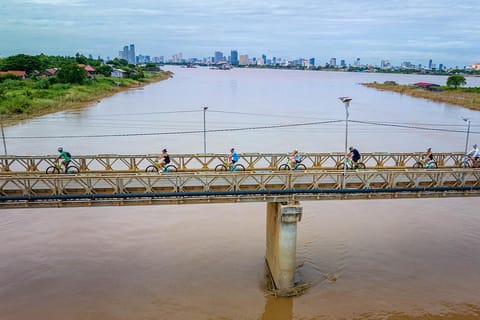
Koh Dach, Silk Island, sits in the Mekong just upstream from central Phnom Penh. A short local ferry deposits you onto a dirt road lined with wooden stilt houses and weaving workshops. The bike route follows the island's narrow perimeter, winding past banana groves, flooded rice paddies that in May carry their first bright green shoots of the planting season, and family compounds where women work hand looms under open-air shelters. The clack of the shuttle is a metronomic pulse beneath roosters and distant motorbike engines. The silk itself is extraordinary up close: raw threads dyed with jackfruit bark and lac resin, stretched across frames in gradients of saffron, indigo, and deep burgundy. Stopping at a weaving house, you can run fingers along finished ikat patterns. Feel the difference between hand-thrown silk and machine-made fabric sold in tourist markets back in the city. The ride is flat, unhurried, entirely rural. Thirty minutes by ferry from a capital city. Yet the air smells of wet earth and wood smoke rather than exhaust.

After a morning walking concrete corridors of Tuol Sleng or sun-baked paths at Choeung Ek, a skilled reflexology session is not indulgence. It is genuine physical recovery. Phnom Penh's reflexology practitioners draw on a Khmer therapeutic tradition that overlaps with but differs from Thai massage. The pressure tends to be deeper and more sustained, focused on the sole's pressure map. Therapists use thumbs and wooden tools that find knots you didn't know you carried. Treatment rooms are typically cool and dimly lit, a sharp contrast to the white glare and humid weight of a May afternoon outside. The scent of lemongrass oil or eucalyptus balm follows you through the session. The effect on feet swollen from tropical heat and hours of walking on hard tile and laterite is immediate and pronounced, a loosening that runs from the arch up through the calves.

The overland route from Phnom Penh to Siem Reap runs roughly 315 kilometres along National Route 6. The road has improved dramatically in recent years. It still passes through a Cambodia that few temple-bound visitors otherwise see. The drive crosses the Tonle Sap floodplain. In May, the landscape begins its annual transformation from dry, cracked earth to the first shallow floods that will eventually make the lake swell to five times its dry-season size. From the vehicle's window you watch the palette shift: tawny browns give way to pale greens as rice seedlings are transplanted into paddies. Roadside villages sit on stilts that in later months will be justified by rising water. A private transfer eliminates the chaos of Phnom Penh's public bus stations and the lottery of shared-minivan driving standards. The vehicle stops when you want, at the spider market in Skuon, where deep-fried tarantulas crunch between the teeth with a taste somewhere between soft-shell crab and dry toast, or at a roadside stall selling palm sugar wrapped in banana leaf, still warm and fudgy from the pot.

A day trip from Phnom Penh to Angkor is a long day. You leave before dawn and return after dark. It solves a genuine logistical problem for travelers whose itinerary cannot accommodate overnight stays in Siem Reap. The route north follows the Tonle Sap's western shore. The temples themselves need no editorial inflation. Angkor Wat's western causeway at sunrise, when the five towers resolve from silhouette into honey-coloured sandstone and the moat reflects them in mirror-still water. Bayon's 216 carved faces, each wearing a smile that shifts between serene and unsettling depending on the angle of light filtering through upper galleries. Ta Prohm, where silk-cotton trees have wrenched apart the laterite walls and their roots pour over doorways like slow-motion waterfalls of pale wood. The included lunch, typically Khmer amok, a coconut-milk fish curry steamed in banana leaf with fragrance of galangal and slok ngor, provides a seated pause during the hottest midday hours. In May, Angkor's crowds thin to roughly half their January peak. The sandstone darkens to a richer ochre when the first rains wet its surface.
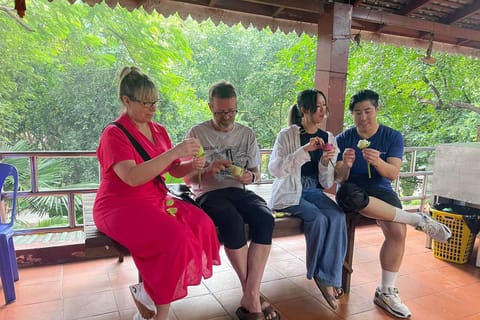
This full-day circuit connects Phnom Penh's three defining sites, the Royal Palace, Tuol Sleng, and the Killing Fields, into a single guided narrative arc that moves from the ornate to the harrowing. The Royal Palace compound opens the day with gilded spires, the emerald-green Baccarat-crystal floor of the Silver Pagoda, and the cool shade of surrounding gardens where the air smells of cut grass and the sweet rot of fallen jackfruit. The Throne Hall's tiered roof glints in the morning sun. The murals lining the pagoda's inner cloister, depicting the Reamker, the Khmer Ramayana, run for 600 metres in pigments that have faded just enough to feel ancient without becoming illegible. From there, the guide walks you through the transition to the Khmer Rouge years. The shift from the Palace's gold and silk to Tuol Sleng's bare concrete and rusted iron bed frames is deliberately jarring. Having a guide through all three sites matters. The connections between the monarchy, the revolution, and the genocide are not self-evident. A good narrator threads them together with specifics that audio guides at individual sites cannot provide. The day ends at the Killing Fields in the late afternoon, when light turns amber through the sugar palms and the site takes on a particular, difficult stillness.
Hand-picked hotels across price tiers for May travellers.
Dates that affect opening hours, transport and crowds
Known in English as Labour Day. Observed nationwide as a public holiday.
Known in English as King Sihamoni's Birthday. Observed nationwide as a public holiday.
Known in English as Royal Ploughing Ceremony. Observed nationwide as a public holiday.
Known in English as Labour Day. Observed nationwide as a public holiday.
Known in English as Royal Ploughing Ceremony. Observed nationwide as a public holiday.
Known in English as King Sihamoni's Birthday. Observed nationwide as a public holiday.
Bookmark this page — your progress is saved between visits
Climate-specific gear, brand recommendations, and what to leave at home.
View Phnompenh Packing List →Insider knowledge and common pitfalls to avoid
Now that you've got the research covered, here's where to go next.
Didn't see anything interesting yet?
Browse Viator's full catalog of tours, day trips, food experiences, and private guides in Phnompenh.
See All Phnompenh Tours on Viator